
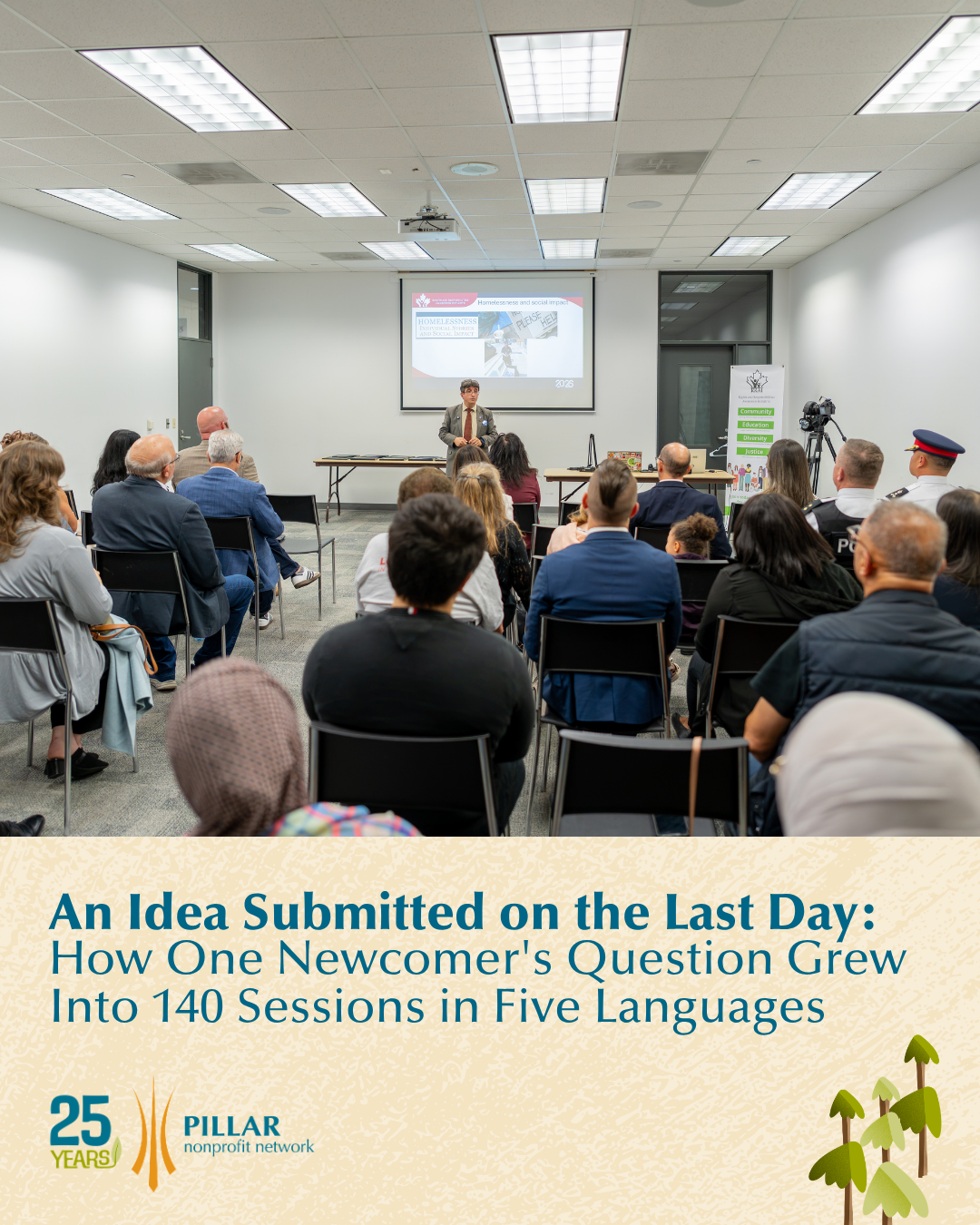
"I feel that I am not alone. I feel that when there is a need for help, there is someone's door I can knock, and this door will be open to me." — Hetham Karky, Founder, Rights and Responsibilities Awareness Initiative
It started on a summer night in a London neighbourhood.
Hetham Karky had immigrated to Canada in 2019 and was working as a visiting scholar at Western University while serving on the school council at University Heights Public School. One evening, he attended an event and asked a simple question: who organized and funded it? The answer was the City of London's Neighbourhood Decision Making program, which lets residents propose and vote on projects for their own neighbourhoods.
The idea came to him right away. He went to his desk. It was the last day to submit ideas.
His proposal was free legal awareness sessions for the community. City staff found it feasible and put it to a vote. It earned 263 votes from neighbours, and the City awarded $3,000 to make it happen.
One Step, Then the Next
The plan was to hold sessions in person. Then COVID hit, and everything was put on pause. The idea kept growing anyway.
"I've noticed that everyone started to turn into virtual platforms," Hetham recalls. So he took the sessions to Zoom. Then he started recording them and streaming them on YouTube. Then came a website. Then RRAI became a nonprofit, and then a registered charity. "So it's evolved," he says simply.
Hetham credits the Honourable Douglas Donald Ferguson, a Small Claims Court judge and former director of Community Legal Services at Western, as the reason the idea became real. Ferguson served as RRAI's first chair and continues to champion access to justice.
Today, RRAI is a volunteer-run registered charity. It has delivered more than 140 free sessions by experts on legal, financial, and cultural issues, offered in English, French, Arabic, Spanish, and Mandarin, and every one is available online.
Preventing the Hazard Before It Happens
For Hetham, the work is about prevention. He points to a Ministry of Justice report finding that newcomers face legal challenges because of language barriers and differences in legal systems. The system in a newcomer's home country may work very differently from Canada's. "Being able to prevent the hazard before it occurred is a great achievement," he says.
That focus runs through RRAI's projects. Together Against Online Crime, its first official collaboration with London Police Service, was a partnership that also included Western University and was funded by the Ministry of the Solicitor General. It produced 20 short multilingual videos to help people recognize hate crime, human trafficking, and online fraud. With London Public Library and RBC, RRAI has also delivered more than 20 in-person financial literacy sessions across library branches.
This year, RRAI began meeting with mayoral candidates and offering them a neutral platform. The goal is to show newcomers from countries where political involvement wasn't possible that things are different here. "You have a vote, you have a right to say, and your voice is heard."
Some of RRAI's proudest moments are its smallest. This past July, during the summer heat, volunteers walked through downtown London handing out cold water to people experiencing homelessness. "It didn't cost much," Hetham says, "but it was greatly appreciated."
A Door That Opens
At RRAI's first board meeting, a board member suggested joining Pillar Nonprofit Network(Pillar), Everyone voted in favour. The next day, Hetham sent an email, and five minutes later he received a warm welcome that "actually touched me at that time."
Pillar soon offered the new organization free space during COVID. "Now we do have an identity, we do have a place," Hetham says. That a "newborn organization" was given space simply because someone believed in the cause "will have my gratitude forever."
The support continued. When funding was tight, Pillar subsidized RRAI's rent. It provided free space to launch Together Against Online Crime. RRAI has found all of its grants through Pillar's newsletter, and almost all of its board members through Pillar postings.
"I feel that I am not alone," Hetham says. "When there is a need of help, there is someone's door I can knock on, and this door will be open to me."
Hope Keeps Us Alive
Funding remains a constant challenge for a volunteer-run organization, and Hetham wants to make sure this work doesn't disappear "just because of a financial aspect of the game." RRAI is also expanding. Mental health awareness will become its fourth focus, alongside legal, financial, and cultural education, and it plans to continue its work on civic engagement and homelessness.
What began as one idea, submitted on the last possible day with 263 votes and $3,000, has grown into more than 140 free sessions in five languages. And Hetham is "looking forward to serving our beloved community again and again and again."
"Hope is what keeps us alive always," he says. "With the positive hope that things will be better tomorrow, and after tomorrow, we will continue."
Learn more about Rights and Responsibilities Awareness Initiative : https://rrlondon.ca/
